13/345 Southport-Nerang Rd, Ashmore Q 4214
12/110 Kortum Drive, Burleigh Heads Q 4220

Cramping in a Marathon/ Ultra-run, should you take a magnesium supplement?

Cramping in a Marathon/ Ultra-run, should you take a magnesium supplement?

By Eatsmart Nutrition Consultants

Just when you feel you have done all the work and you are on track for a P.B., BANG, the dreaded calf cramp at the 32km mark of a marathon, or it starts at 65km into 100km ultra-run.  So will taking magnesium prior to the run prevent this?  To answer this question we will look into what a muscle cramp is and why it happens.

An Exercise Associated Muscle Cramp (EAMC) is a sudden, involuntary painful spasm or contraction of a muscle.  Usually it will happen in one of the active muscles of the activity you are doing, for example, when running; a calf cramp.

As much as the supplement companies would like you to believe that taking a magnesium supplement will stop you from cramping, scientific evidence to date suggests there is not a strong link between EAMC and magnesium supplementation.  The most agreed upon theory is that EAMC is fatigue of the exercising muscle.

What does cause a cramp then?

The common risk factors are:

–       Having a history of cramps (you are a cramper!)

–       Increased exercise intensity and duration (and unfortunately in a marathon, you never quite replicate those racing conditions for the same duration in training)

–       Inadequate conditioning for the race or event (you haven’t trained enough!)

–       A family history of cramping may also make you more at risk

–       Glycogen depletion, which leads to fatigue of the muscle

A balanced diet should provide you with adequate magnesium and therefore a magnesium supplement should not be needed.   Foods which are high in magnesium include nuts, seeds, fish, legumes and wholegrains.  Those who are doing very high levels of training or are eating a restricted energy intake could be at risk of a magnesium deficiency (or other deficiencies!) but before taking any supplementation, it is important to discuss with your doctor.

So how can I best avoid a cramp?

–       Have a hydration plan.  Know your hydrated weight and make sure you are consuming enough fluids around and in training to keep yourself hydrated.  Prior to an event, you should make an effort in the days leading up to concentrate on your hydration and make sure you carry a drink bottle with you and sip!  Your hydration needs during the event differ from person to person but between 600-1000ml / hour is a good start.  You also should be consuming a source of sodium, which easiest way done is through a sports drink.

–       Train!  Leading up to a marathon or any endurance event, you have to have done an appropriate program to make sure your muscles can cope with the load of the event.  You need to have had at least a 12 week lead up and a prior endurance base.

–       Make sure you carbo-load and have a fuelling plan during the event.  Anywhere from 30-60g of carbohydrate per hour is recommended in order to prevent glycogen depletion and to keep your muscles fuelled.  Not only will you prevent a cramp, but you will have more energy to finish!

If you need help fuelling for your marathon or with your hydration plan or worried about your intake of magnesium, see one of Eat Smarts Accredited Practicing Dietitians. Amelia Webster is available for consult at both Runaway Bay and Burleigh clinics. Ph 07 5500 6470 for an appointment to help you!
Taping Techniques

Taping Techniques used at Gold Coast Physio & Sports Health

Basic Ankle Strapping to reduce the risk of Sprains

APA Titled Sports Physio Britt Caling demonstrates basic ankle strapping at Gold Coast Physio & Sports Health

Ankle Taping for Specifically for Trail Running  (including the 96km Kokoda Challenge)

Basic ankle strapping demonstrated by Olympic Sports Physio Britt Caling

Plantar (underneath) Foot Taping for arch support and reduction of blisters

Basic tips & Plantar strapping demonstrated by Olympic Sports Physio Britt Caling

Toe Taping for Ultra-running to prevent blisters

Basic tips & toe strapping demonstarted by Olympic Sports Physio Britt Caling

Knee-cap taping for Patello-Femoral Pain

APA Titled Sports Physio Britt Caling demonstrates basic knee strapping at Gold Coast Physio & Sports Health

Stretching for Cyclists – Part 1)

Stretching for Cyclists Part 1

Words by Gold Coast Physio & Sports Health Sports Physio and avid cyclist Andy Frith

I’m often asked “what are the best stretches for cyclists?” The answer is not as easy as it sounds. Firstly everyone has a different body shape and each cyclist has a different pedal stroke and style so a stretching program is very individual. Some people need to stretch more than others to be able to obtain a more ideal cycling position to optimise performance, while other cyclists may be inherently flexible and may need little stretching to perform well and stay injury-free.

For those of you that need- or feel like you benefit from- stretching, below are some stretches based on reducing the indcidence of 2 of the most common injuries in cyclists; knee pain and lower back pain.
If you have wither knee or back pain, these can be addressed by by a bike fit qualified physiotherapist who would look at managing training load management, bike- fit and your kinetic chain.

The following stretches done pre and/or post ride address common soft tissue restrictions seen in cyclists andmay help prevent injury.

Hold each stretch into a gentle range so that you can relax into the stretch while you hold it, and hold as long as you need to until that stretch sensation has eased.

Stretches:
1. Fit ball quad stretch (or if you are unstable using a fitball, use a chair under your rear foot, and you may also need a pillow under your stretch knee for comfort)

The best bang for buck cycling stretch to target your quads and hip flexors. These muscles are always in shortened positions when you ride and you need length in these muscles to funciton in uprgiht positions off the bike without low back pain, and you need mobiliy in these tissues around the knee to reduce incidence of knee pain.

• Begin in a crouch runners start position, with the foot and ankle to be stretched on the ball.
• Slowly rise upward.
• You may need to place one hand on the ball or use a chair for support.
• Draw in your belly button toward your spine and roll your pelvis under so your back flattens to increase the stretch.

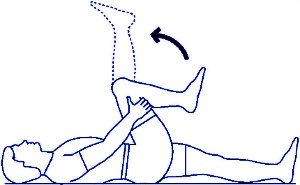
2. Hamstrings/ Nerve Stretching

Your hamstrings never fully straighten when riding, it’s important to keep them long for you back health. Having good hamstring/lower limb nerve length will also help you get into a good areodynamic positions. Improving aerodynamics means less resistance from air and wind and therefore improved speed and performance

• Lie on your back with a small rolled up towel under your back at belt line level.
• The towel, when compressed should be the width and thickness of the fattest part of your hand.
• Grab the back of one leg with both hands, just below the knee, and bring the leg up until the thigh is perpendicular to the floor. Point your toe and slowly straighten your leg without letting the thigh move in your hands or letting your back come off the floor.
• Hold a comfortable stretch for 20 seconds, or if it feels more than muscular, your nerve pathway may be limited in its mobility and therefore, oscillat gently in and out of the stretch until the intensity of it eases.

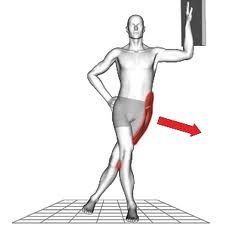
3. Illiotibial band (ITB) stretch down the side of your leg

ITB tension and a saddle too high (or low) can cause knee issues.

• Stand next to a wall and step forward of your inside leg as shown.
• Keep both feet flat on the floor.
• Use your inside arm for support against the wall and place your other han on your hip.
• Press your hip toward the wall and slightly downward as it moves closer to the wall.
• You should feel the stretch on the outside leg and hip of the leg closest to the wall.
• If you do not feel the stretch, bring your hips forward slightly and rotate your pelvis toward the front.
• You should not feel the stretch in your low back.
• Hold until it gives. Stretch each side up to 3 times.

As I previously mentioned everyone is different and other stretches may benefit certain people but for most cyclists these will hit most trouble spots. Your Physio or Massage Therapist can also guide you on the best area’s for you to do self-massage, foam roller or trigger-points to help your peformance and keep you injury-free.

Happy riding, stay safe and I’ll see you on the road!
Andy Frith
Sports Physio, Gold Coast Physio & Sports Health
www.mygcphysio.com.au

Acknowledgements
Parts of this article were adapted fromPaul Visentini and Ben Clarsen’s article in Aspetar Sports Medicine Journal Volume 5 October/ November 2016. The Illustations were found in Paul Chek’s book “How to Eat, Move and be Healthy” 2004.

Tasty & Healthy Buckwheat Pancakes

Buckwheat Pancakes

by Eatsmart Nutrition


Now, the name is a little deceiving, buckwheat is not a grain it is actually a fruit seed related to the rhubarb family, which makes it gluten free and coeliac friendly! You can buy buckwheat flour from most big supermarkets or health food stores. The flour is versatile, and makes a great pancake mix! Pancakes can be a tasty pre- training gluten free carbohydrate snack! You can make these in advance and freeze then for up to 3 weeks, and just heat them in the microwave before training. A quick, easy snack when on the go.

Ingredients (makes 8 small pikelet size, or 4 large pancakes)

1 cup buckwheat flour

1 teaspoon baking soda

2 tablespoons honey

1 cup milk

1 egg

1 teaspoon vanilla extract

jam or frozen berries to serve

Method

  1. Mix all ingredients together in a large bowl until a smooth batter forms (buckwheat can soak up a lot of liquid so you may need to add a little more milk to get the right consistency).
  2. Heat a small amount of oil in a pan, add the pancake mixture to the pan (small or large depending on if you are making pancakes or pikelets)
  3. Once the pancakes have bubbles on the surface, they are ready to flip and cook until the opposite side is golden brown.
  4. Serve with 1 tsp of jam for a pre-training snack, or some frozen berries and yoghurt for a lazy Sunday breakfast.

Compression Clothing – why and when to use it

 Compression Clothing

Why use Compression in Sports clothing?

One of the newest trends for recovery in the athletic market, is the use of compression clothing. So what is all the fuss really about? What is compression clothing? and What do I use compression garments for?

Compression garments are a relatively new tool for athletes and research is currently being undertaken to determine all the true benefits.

What they seem to do is help both performance and recovery by:

Improving athletic performance by maintaining repeated jump performance – great for sports like AFL where repeated jumps in a game are crucial for keeping possession of the ball
Reducing muscle movement and vibration and focus the direction of the muscle-  excellent for distance running or activities where there is a repeated movement pattern over-and-over again in order to reduce muscle fatigue from the vibrations and reduce the metabolic cost of running

sports massage physio Burleigh Runaway Bay Gold CoastMaintaining body temperature and moisture wicking – particularly useful for keeping the body warm in colder environments and helping the body during warm-up.  Surprisingly, the moisture-wicking ability allows these garments to evaporate sweat and also helps keep the athlete cool in hotter environments.

Assisting in the athlete’s psychological recovery from repeated bouts of exercise compared to passive recovery – obviously useful to perform well when the athlete needs to back-up in multiple games (ie. duirng Touch Footy carnivals) or for multiple events (ie. Swimming championships)

Reducing the time taken for muscles to repair themselves by altering muscle metabolites and swelling produced during exercise and also reducing muscle soreness during post workout recovery following eccentric (muscle lengthening) exercise – almost every competitive sports involves eccentric muscle contractions so this suggests compression garments are excellent for helping muscles recover to a more normal state, and faster, following sport

They may also be an alternative to Compression stockings worn during long flights to reduce the risk of Deep Vein Thrombosis (DVT) caused by pooling of blood in the lower legs

They provide support to help keep male genitalia in place, are great under short skirts (such as womens hockey) to avoid exposing underwear and help reduce chaffe between the legs when running.

Why should I use compression garments?

A compression garment is a form-fitting garment that athletes wear for a number of reasons of performance benefit (see below). They are usually made of a combination of Nylon and Lycra so that they provide a firm compression to the limb/body part over which they are worn.

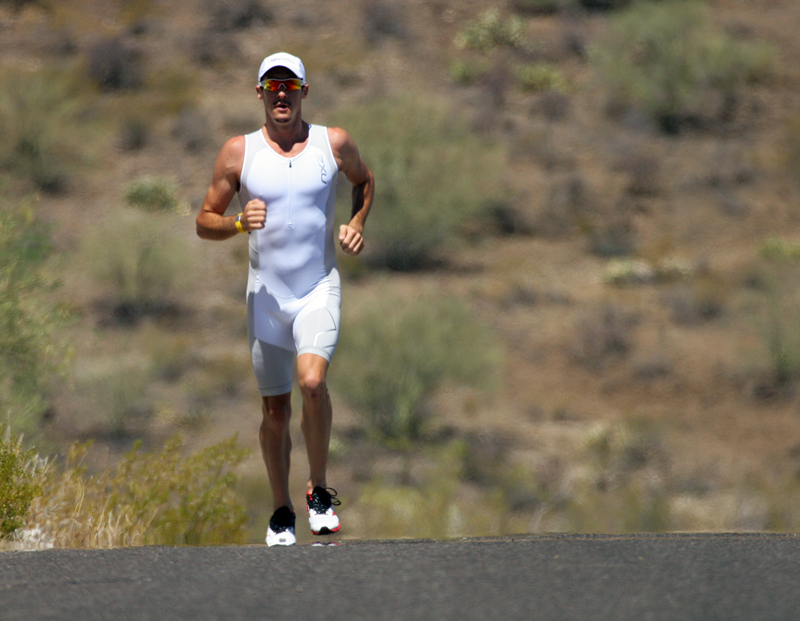
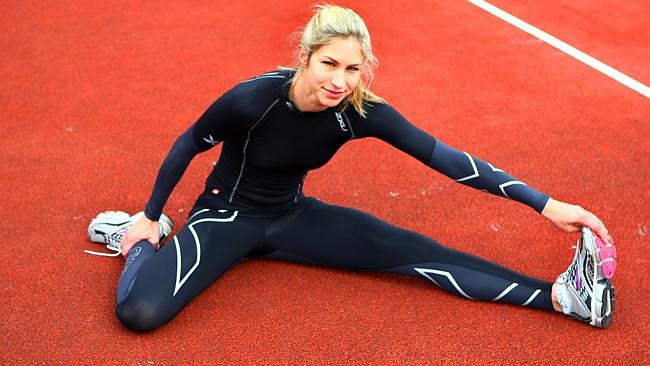
Examples include: long ankle-length tights, knee-length shorts, full-length arm shirts, tee-shirts, singlets, calf-guards (covering just the shank-region and are used by many runners – see photo of AIS triathlete Dan Wilson), calf-guards with stirrups around the feet (perfect for soccer/hockey/football or sports where shin guards need to be kept in place or for orienteering) and socks.

Compression Garments may have many benefits and I would recommend them to any sportsperson or even social competitors who don’t like feeling sore after exercise. All you need is one garment and they do last a long time!

I personally wear long compression tights for the duration of an event when I’m competing in long distance running and long adventure racing.  I also wear my long tights immediately after (and I even sleep in them) if I am particularly sore from a training session or race, or when I need to back up racing from one day to the next.  And I wear my calf guards for Orienteering or Rogaining as they provide both compression benefits and act as a very light-weight leg protector.

Where do I buy this exciting clothing?

There are many brands now making compression clothing. At Gold Coast Physio and Sports Health we stock 2XU compression clothing.  The 2XU brand is the official choice in compression for the Australian Institute of Sport and they provide a higher level of compression than many other brands by the type of Denier in the fibre they use and also the circular knit that they use to make their compression items.

If 2XU is good enough for the AIS, then we figure it’s good enough for Gold Coast Physio and Sports Health clients! Take a look at our range of 2XU compression garments – we even have the NEW coloured range!

or if you would like to try on any compression garments, please visit the Runaway Bay or Burleigh Clinics ph 07 5500 6470

Yours in Good Training,

Britt Caling APA Titled Sports Physio, Gold Coast Physio & Sports Health

Loading...