13/345 Southport-Nerang Rd, Ashmore Q 4214
12/110 Kortum Drive, Burleigh Heads Q 4220

Exercises when travelling to prevent blood clots

By  Gold Coast Physio & Sports Health Massage Therapist Fred Impens

With Christmas and School holidays coming soon many of you are probably making plans to drive or fly to your holiday destination .  If so, please keep in mind that you may need some travel exercises to take with you for a number of benefits.

Why exercise?
Traveling exercises are important for any holiday, especially if it involves travelling a long distance without stopping.  It would be great if you could stop every hour for some exercises during your trip, but sometimes this is not practical, especially if you are stuck in the window seat of a plane.

Exercises during your trip help prevent deep vein thrombosis (DVT) from forming in your legs.  DVT’s are blood clots that can form in your legs when blood pools in your veins.  Small blood clots are acceptable, medium clots can cause swelling, stiffness and pain, and more severe clots can endanger life by mobilizing to your heart or lungs.

Exercises to do:

Here are a few exercises that are easy to do, easy to remember and you won’t have to get out of your seat.

Foot Pump:
Sitting in your seat, start with your feet flat on the ground, then lift your heels up, then lower them down, 20-30 times.

Knee Lift:
Lift your knees one at a time towards your chest, hold 10 seconds, 5 – 10 times each leg.

Shoulder Roll:
Roll your shoulders up, back and down 10 times, then roll them up, forwards and down 10 times.

Neck Roll:
Roll your neck clockwise 10 times, and then counter clockwise 10 times

Shoulder Stretch:
Sitting or standing cross or link your fingers together and then slowly push your arms straight up with your palms facing the ceiling  10 times.

Trunk Rotation:
In the seated position,  turn your upper body as if you were looking at the person seated behind you 5 – 10 times.

These should be done every hour, and if you are in an aeroplane and it is practical, then walk round and do some standing calf raises every hour as well.

If these exercises cause pain, stop them immediately. Get yourself to your local GCPSH  physiotherapist or massage therapist to get advice on what is safe and effective for you to do.

How about compression socks?

Compression socks are a useful addition to your luggage for any long haul trips.

While we don’t recommend compression socks along, they are a great adjunct to your exercises at reducing the risk of DVT.  Compression socks work by minimising the pooling of blood in your lower legs, therefore reducing the likelihood of a clot developing.  They are simply to use, don’t take up much space and are comfortable.

At Gold Coast Physio & Sports Health we stock 2XU Compression Socks in 2 styles:

– travel compression socks that can also be used for recovery from training

– race compression socks that can be worn during competition

See us at Runaway Bay or Burleigh Clinics to trial a pair of compression socks prior to your next long trip, or check the 2XU range by clicking here

Don’t forget current clients receive an additional 10% off our already lower prices on ALL 2XU compression and performance clothing.
 

Knee pain when you run or ride? It could be ITB Friction

By Sports & Exercise Physio & Olympic Physio, BrittCaling

What is the ITB?

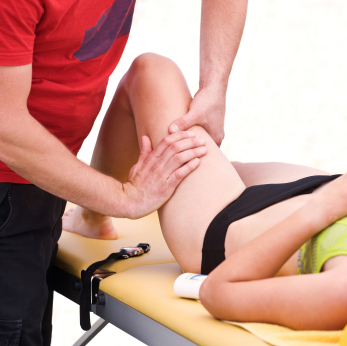
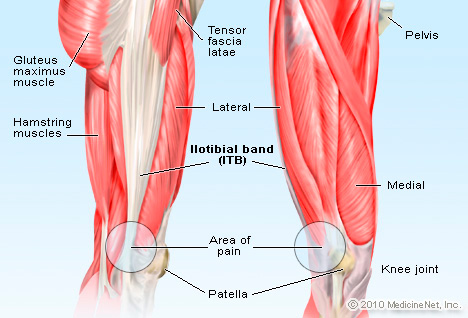
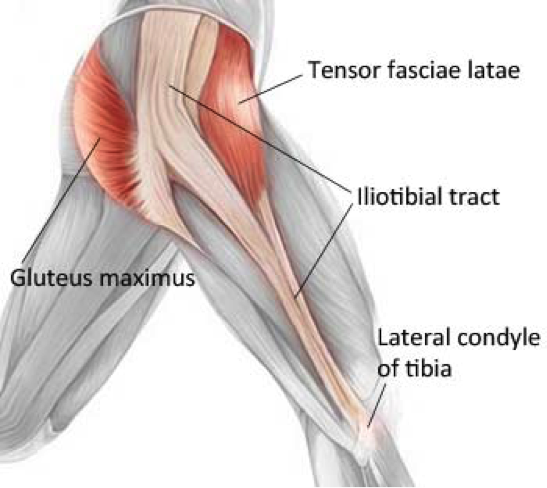
The Iliotibial band (ITB) is a thickened sheet of connective tissue (fascia) that originates at the edge of your pelvis/hip and then runs laterally down the outside of your thigh to insert just below your knee.

What is ITBFS?

ITBFS (ITB friction syndrome) is a common running injury that causes pain on the lateral (outside) aspect of the knee. ITBFS occurs as a result of excessive rubbing (“friction”) of the ITB as it runs over the bony prominence on the lateral part of the femur (the lateral femoral epicondyle), or over the small bursa (fluid-filled sac) that sits between the ITB itself and the bone. As the knee is continually flexed (bent) and extended during running the ITB continues to rub over the bone/bursa until it becomes inflamed and painful.

What causes ITBFS?

ITBFS is an overuse injury caused by a number of training and biomechanical errors, resulting in the excessive friction of the ITB over the lateral femoral condyle:

  • Sudden changes to training load or running surface (especially running on cambered roads),
  • running shoe changes and
  • changes to running technique are all common training errors that may lead to ITBFS.
  • Biomechanical issues that may cause ITBFS include weak gluteal muscles, an excessively tight ITB due to muscle or soft tissue tension, potentially an unadjusted leg length discrepancy, and most significantly running technique (particularly where your foot strikes the ground and how your knee and hip are used during your running techniue).

All of the training and biomechanical causes, particularly running technique, can be identified and treated by your physiotherapist.

Symptoms

ITBFS often starts as a stinging/rubbbing/tender sensation on the outer edge of the knee when running. This sensation will progressively become painful and may be on the outer edge of the knee, or just above or below the knee. The pain may not start at the immediate onset of running, but often begins half way through the run and then progressively becomes more painful. As the ITBFS gets worse the pain may persist after activity, or even be painful during activities of daily living.

Pain may be worse on different cambers of surface.

Treatment

Treatment is firstly aimed at reducing your current symptoms and then secondly addressing the training and biomechanical causes of the ITBFS. Some common treatment techniques include soft tissue release of the ITB, dry needling (a form of acupuncture), taping to de-load the ITB attachment at the knee, biomechanical (video) analysis, and an exercise program to address your specific areas of tightness and/or weakness.

Sometimes a Cortisone injection into the bursa is also warranted for non-resolving pain.

Your physiotherapist will tailor the treatment to best suit your current symptoms and identified causes.

What can Gold Coast Physio & Sports Health Therapists do for ITBFS 

The physios at mygcphysio are experts in biomechanical analysis and assessing running technique. After completing a thorough assessment to identify the causes of the ITBFS, they will then assess your running technique to determine any biomechanical related causes. This will then allow them to specifically address your running technique with drills and exercises, as well as hands on treatment tailored to you.
All physio’sat GCPSH are trained and qualified in a form of acupuncture called dry needling which may also aid with your recovery.

We also have a Sports & Exercise Medicine Physician available for Consult in clinic for non-resolving pain that is not settling with this conservative management. Our Physician may order Investigations such as MRI or Xray to ensure the pain is not coming from a different tissue source, and they are able to assess and help decide with your Physio whether a Cortisone may be warranted.

We also hold a Running Technique Clinic once per month to help improve your running mechanics and technique, click here for more information regarding the class.

If you need help with outside Knee pain that you think could be ITB related, phone us on 07 5500 6470 or Book Online to see us and let us help you get back to the exercise and sports you love!

ITB friction & gold coast physio & sports health

We helped the K4 kayakers to Gold!

How awesome are these guys! Well done to Tate Smith, David Smith, Murray Stewart and Jacob Clear for their so-deserved Gold Medal at the London Olympics in the mens K4 flat-waters kayaking.

As with all our other elite athletes representing Australia at the games, we are so proud to say we have been part of the process and journey in helping these guys achieve the ultimate in sports performance!

Olympic Gold to Sally Pearson & We Helped Her Get There

Gold Coast Physio & Sports Health wants to congratulate 100m Hurdles World Champion and new Olympic Gold Medalist Sally Pearson on her feats in London.

Sally adds this Gold medal to her Silver from Beijing and we are so proud to have supported Sally with her Sports Physio and Massage provision over the past 4years that we have been open.

Don’t forget to find out about our Olympic Fever Discount offer associated with Sally’s medal! Click Here

Our Sports Physio, Britt Caling has been the Gold Coast based Sports Physio to Sally for 7years now and has seen her develop into the best athlete in the World. Britt also had the pleasure of spending 3weeks working with Sally in preparation towards London.

Well done Sal – we are so proud to be associated with you!

2 Massages for the Price of 1- Be Quick valid 2 weeks only!

You benefit from Gold Coast Physio & Sports Health welcoming new experienced Massage Therapist Simon Poxon to our great team.

As a special Welcome, for 2weeks only (until sat 3rd Nov), we are offering 2 Massages for the price of 1!  What a great deal!

Just book 2 massages and you will get each massage for half the price.

Health fund rebates are still available in clinic with this offer so for TWO x 1 HOUR MASSAGES YOU WILL ONLY PAY AROUND $20 per massage.

This offer is valid for Massages at our Burleigh clinic only for bookings with Massage Therapists Simon, Poxon, Fred Impens, Liane Wild and Chloe Wakeling

There are a limited number of discounted appointments available so be quick and book ahead of you”ll miss out.

Book now by phoning the clinic (07) 5500 6470, email us on info@www.gcphysio.robicoweb.com.au


Loading...