13/345 Southport-Nerang Rd, Ashmore Q 4214
12/110 Kortum Drive, Burleigh Heads Q 4220

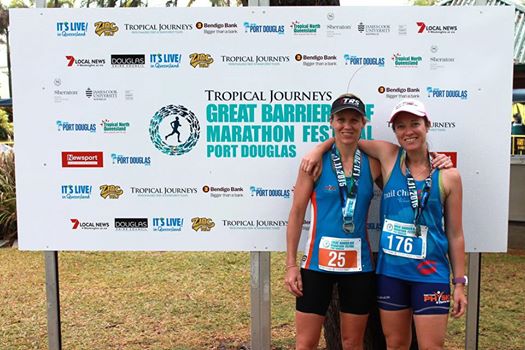
Winning The Great Barrier Reef Marathon Festival 74Km Ultra Run

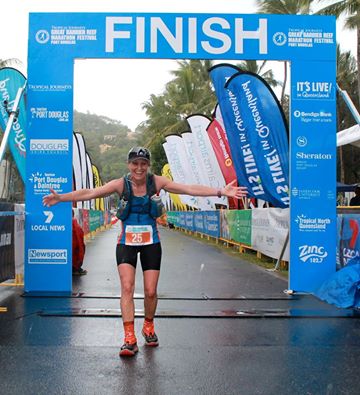
In 2015 I won the overall Womens title for The Great Barrier Reef 74km Ultra-run. I was 3rd overall, less than 30min behind the leading male, and only 20sec behind 2nd place overall. What, Why and How did it Happen?

By APA Titled Sports Physio & GCPSH Principle Sports Physio Britt Caling

This festival is held in the beautiful location of Port Douglas, Qld includes a number of events from a 2.5km dash, to a marathon, and also the 74km Ultra-run.

I had decided in 2015 I needed a challenge to help make my 40th Birthday become ingrained in my memory- and who needs a party when you can go and run 74km instead! So off I pottered with my family to Port Douglas at the start of November for a holiday and a run experience.

The 74km run seemed like a great option for an event due to its location and the mix of running involved: starting at 4am with head torches, the first 4.5km was run along the hard-packed and iconic 4-mile beach. Being dark in Port Douglas until after 5.30am meant the beach run and next 7.5km along paths/roads of the resort township was all run in the dark and time seemed to pass really quickly, so before I knew it I had reached the only real climb of the event- the notorious “Bump Track”.  The Bump Track is an ascent of 360m over 2.2km so it is similar to the numbinbah side of Polly’s on the Gold Coast but far shorter and easier underfoot, and after this initial steep section it continues undulating upwards for another 4km.

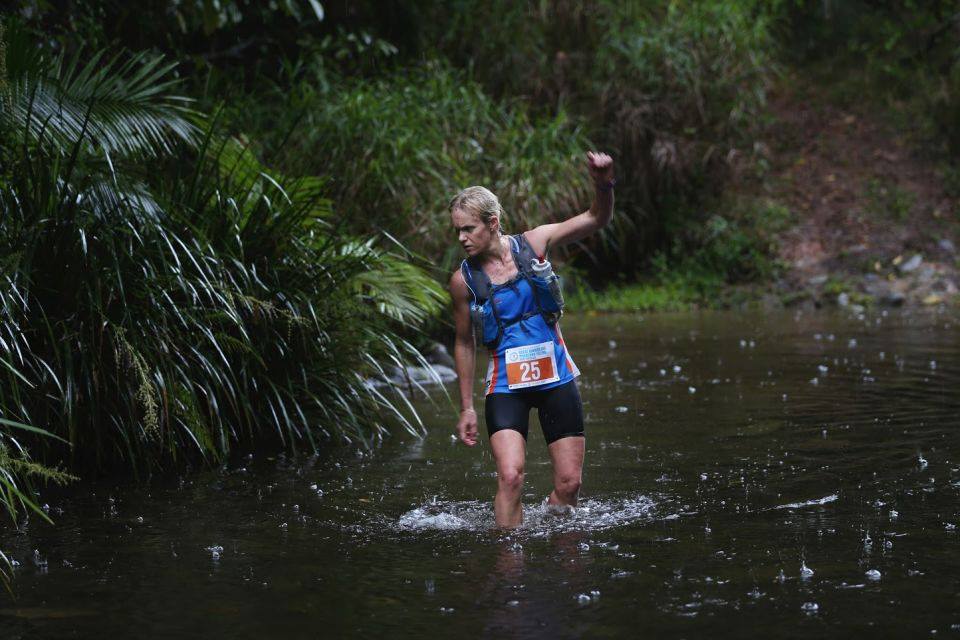
The run challenge continued through rainforest on very runnable fireroads until around the 36km point when it became singletrack-type running in dense rainforest. There were a couple of creek crossings helping to make the location and scenery just superb.

The Ultra run returns in a big loop to the top of the Bump track and then descends and returns the same way home, except this time along 4-mile Beach I had the opportunity to appreciate the scenery and location during the light.

With the technical trail running and steep hills I am used to training on around the Gold Coast this run really was easy underfoot. The possible heat/humidity of the event had been a concern during my training preparation but for the week holiday in Port Douglas pre-event, I realised the humidity wasn’t anywhere near as bad as expected. On race day it started sprinkling rain as we were walking to the start line, and the rain continued in patches for the whole day, which made the conditions for all events of the festival easily tolerable for 2015.

Leading into the event I had completed a Run VO2max Exercise test at our Gold Coast Physio & Sports Health clinic to provide me with training and race pacing, so I had some idea on the running speed I could handle, but over a 74km event many things can happen that can cause you to lose time pretty quickly. For long events, I always focus on what I call the “3 F’s”: Food, Fluid and Footcare. Food and Fluid should be self-explanatory and in the past I have used Sports Dietitians to help guide me on different food and electrolyte options, but Footcare refers to taking care of your feet so they can cover the distance. Foot pain, including blisters or painful toes, can stop you in your tracks. My strategies for this involve wearing shoes ½ size bigger than normal for the long events, and you need to make sure your shoes are suitable for the terrain and length of time running. Socks are also very important and must have been trialled in long runs prior to race day (I use wool toe-socks), plus I  tape all my toes with physio tape and I recommend having blister patches in your race pack and using them as soon as a rub spot is felt (and not leaving the rub until it is painful).

My background prior to trail running was Adventure Racing, of which I have completed a number of 48hr events. With this experience behind me and knowing I had been thorough in my preparation in both my training and with a weekly Physio or Massage appointment for maintenance at Gold Coast Physio & Sports Health clinic, I knew if I could get the “3 F’s” right on race day, and use my Exercise Test pacing strategy, then my brain would get me through the end stages of the run and I would go alright.

On race day I surpassed all my expectations, winning the womens event in a time of 7hr 44min (6:16min per km) and finishing 3rd overall (20sec behind the 2nd placed male). Rob Clarke made it a Gold Coaster double by winning the mens in 7hr 23min.

Overall, the event was well-organised and the course was not only scenic and beautiful, but it provides a nice variety in running to keep you stimulated. For anyone wanting a challenge more than 50km, but thinking 100km sounds daunting, then this event is very achievable with the right preparation and I would highly recommend a holiday with just a small run thrown in!

Happy Run Training,
Britt Caling
Sports Physio
The ITB – What is it? Why does it hurt? How to treat it

The ITB – What is it ? Why does it hurt ? How to treat it!

Words by Remedial Therapist Dan Collins (Dip Remedial Massage)

The Iliotibial Band (ITB) has a poor reputation in sports and sports medicine. Mention your ITB and knowing nods and shakes of the head abound. The ITB is often associated with sports injuries and problems such as iliotibial band friction syndrome and anterior knee pain: and we all know…it hurts !

The ITB is, however, connective tissue, it doesn’t contract, or relax and you can’t directly strengthen it or lengthen it.

So what it the ITB ?

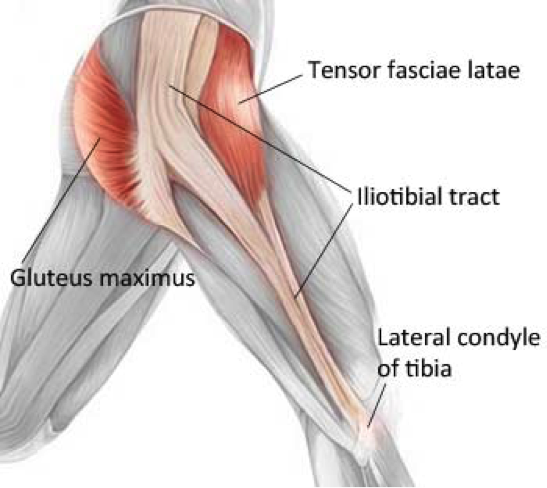
The ITB is actually a thickening of the lateral (outer) soft tissue that envelops the entire upper leg. The thickened band is called the ilio-tibial band (ITB). The muscles that insert into the proximal (upper) portion of this band are the Tensor Fascia Latae and a portion of the Gluteus Maximus and Gluteus Medius muscles. At its lower section the ITB splits medially into the ilio-patellar band and laterallyinto the iliotibial tract. The ITB is also anchored to the femur (thigh bone) via the intermuscular septum (tissue between the lateral quads and the hamstrings).

Iliotibial band anatomy:

So, basically, the ITB is a passive structure that is influenced by the muscles around the region – the TFL and Glute Max muscles that attach to it proximally, and the quads and hamstrings that can pull and tug on the fascia latae which in turn can create stress and tension on the ITB. Weakness and/or asymmetry in any or all of these muscles, combines with repetition (eg: running and cycling) can contribute to ITB issues.

The most common treatments for “tight ITB’s” is usually massage, dry needling and using a foam roller (ouch !!!). These treatments will often work; however the main reason for this improvement is due to reducing tone/tightness in these adjacent muscles the contribute to ITB tension and not by stretching or releasing the ITB itself: remember the ITB is connective tissue that can’t really lengthen (0.2% max).

In the end weak muscles get tight – so the main issue is usually strength defecit, sometimes biomechanical, sometimes overuse, sometimes a combination, rarely flexibility. So here are some basic self help tips for treating your ITB Syndrome.

*Strengthen your hip abductors (gluteal muscles especially the glutes medius).
*Side Stretching
*Regular remedial massage for those tired and tight muscles
*Gentle foam rolling (not too hard and not too painful)
*Avoid crowned surfaces or too much track running
*Examine your training regimen – speak to our very own Exercise Physiologists @ GCPSH to help you put a programme together
*Check your bike set up or get a professional bike fit – available at GCPSH

Dan Collins is available for consult at Burleigh & Runaway Bay ph 5500 6470 

Here’s to a happier ITB !

References:
Randall Cooper –  Sports Physio; Melbourne. “The Ilio Tibial Band and it’s treatment”.
Stephen M. Pribut, D.P.M. ITB Syndrome: “Cause, Cure and Your Core”
Brian Fullem, D.P.M. “Treating ITBS”

Do you suffer from Recurrent Shin Splints?

Do you Suffer from Recurrent Shin Splints?

What a pain in the bone!

Words by APA titled Sports & Exercise, & Australian Olympic Team Physio Britt Caling

Shin Splints can be defined as “pain along the inner edge of the shinbone (tibia).” (American Orthopaedic Academy). ‘Shin Splints’ is the lay term for what is more commonly referred to as “Medial Tibial Stress Syndrome (MTSS)”.

MTSS is common in runners accounting for up to 17% of run-related injuries, and is also reported in other athletes that engage in jumping/plyometric type activities. It is characterized by pain on the inside of the lower leg in the region between ankle and knee, and is often more localised to the lower third of the tibia bone. MTSS pain is worse with activity and responds well to rest. Other signs and symptoms include:

–        Pain on running, jumping, landing, increased weight-bearing activities which initially does not cause you to stop, however, this may be the case if symptoms and activity continue.
–        The pain is normally described as an intense ache that reduces when the activity is ceased.
–        On palpation there is pain along the lower inside border of the tibia.
–        After activity the pain settles within 48 hours and does not wake you up at night. Often symptoms are worse on initial start-up of activity and improves through the session with worsening post-session/warm-down

The cause of MTSS may need to be differentiated as arising from:

1. Tibial bone overload, bone stress and possible early signs of stress fracture. During weight-bearing activities, the tibia bends causing bone strain. This strain normally causes micro damage in the bone, and a healthy response is for the bone to adapt to this by laying down more bone and becoming stronger. However, when the strain exceeds a certain threshold and the bone becomes overloaded, the bone cells may start to breakdown causing symptoms of bone stress.

2. Soft tissue origin due to traction of a tissue deep in the back of your calf. A tissue in your deep calf compartment called the intermuscular septum, in combination with the Flexor Digitorum Longus (deep to the calf muscles) and Solues (part fo the main calf muscle complex) muscles have a local attachment onto your tibia. This attachment may become symptomatic due to poor strength of your gastroc calf muscle, poor foot function and intrinsic foot muscle strength and poor differentiation of muscle within your deep calf.

Treatment for each of the 2 above causes is very different so if you experience MTSS pain it is essential to have your Sports Physio perform a thorough history & assessment to provide you with an accurate pathway of management.

Detailing specific treatment is beyond the scope of this article but should be discussed with your GCPSH physio because it needs to be individualised.

Prevention of MTSS involves:

–       Maintaining excellent calf strength in both gastroc and solues. Your Physio can test your current calf strength-endurance capacity and guide exercises to improve this if needed.
–       Establishing and maintaining good foot muscle strength and function. This can be achieved with foot muscle exercises and good technique in your sport. A visit to your Podiatrist may also be needed to guide the best shoe for you and/or prescribing orthotics to assist good foot function.
–       Care with the addition or progression of weight-bearing exercise or activities in your training. Both your bone and muscular systems need time to adapt to any ground reaction forces. Liaise with a good coach to ensure your training is appropriate for you. Alternatively, discuss your training loads and progression with our GCPSH Exercise Physiologist or one of our Experienced Sports Physio’s.
–       Discuss with your Physio the best surface for you to be training on.
–       Regular performance of plyometric exercise (jumping, bounding, skipping exercises)  in a limited form will assist in maintaining healthy bones. The use of these exercises needs to be guided by your Physio and/or Coach and/or Strength & Conditioning Coach. While these exercises are good for bone density, caution must also be used when adding/performing them and It is essential these exercises are performed in appropriate moderation, and with your training and medical history taken into account.

Other differential diagnoses for shin pain include: compartment syndrome; popliteal artery entrapment; various neuropathies; and frank stress fracture (there remains much controversy in the literature about whether MTSS and stress fractures are a continuum).

Should you be concerned about whether you have MTSS or a presenting differential diagnoses, seek an appointment with a GCPSH Sports Physio or our consulting Sports Physician for a thorough and detailed management.

Phone us on 07 5500 6470 for an appointment, or Book Online.

WHY DO I KEEP GETTING INJURED?

Why Do I Keep Getting Injured?

Words by Sports Physio Myles Burfield, B.Physio; B.Ex.Sc

Ok! Let me preface this article by confirming that nobody is invincible, and everyone has a breaking point when engaging in active and sporting pursuits. But what is your breaking point? And how do you find it safely, without breaking too many times? The answers to these questions are integral to achieving your training & competition goals and preventing injury.

Over the past few years the Australian Institute of Sport (AIS) has been compiling data on injury and relating it to load (load= the amount of training or activity you complete). Amazingly what they found, in over 1000 athletes, across 7 different sports, is that if you change your load too much from week-to-week then you get injured (in a nutshell). What is even more amazing is that what they found was almost exactly equivalent to the research done by Cricket Australia, Rugby League, and Australian Rules Football (Blanch & Gabbett, BJSM, 2015).

So what this effectively means is that it doesn’t matter if you are a sprinter, distance runner, swimmer, footy player, gymnast (I could go on, but you get the drift), if you don’t manage your ‘load’ correctly, then you WILL break down.

Sound like Common sense? Well yes, but surprisingly most of the injuries Physio’s see are overuse injuries (and even some acute injuries) and are from people breaking the basic loading rules.

Defining Load from Sport to Sport

“Load” is a word we use to describe the total stress on the body over a period of training. It can be calculated in a number of different ways i.e. measuring distance you swam/ran/paddled/cycled/sprinted etc, measuring your heart rate, perceived effort, or time spent training etc. Or Even a combination of the above.

For their research the AIS calculated load as ‘training time’ multiplied by ‘rate of perceived exertion (RPE)’, which is how hard you felt the session was over all {ie time x RPE}, but you can trial different values and see which works for you. For more help with this, chat to your Physio.

So what are the “rules” you ask eagerly?

Well the simple interpretation of the data dictates that:

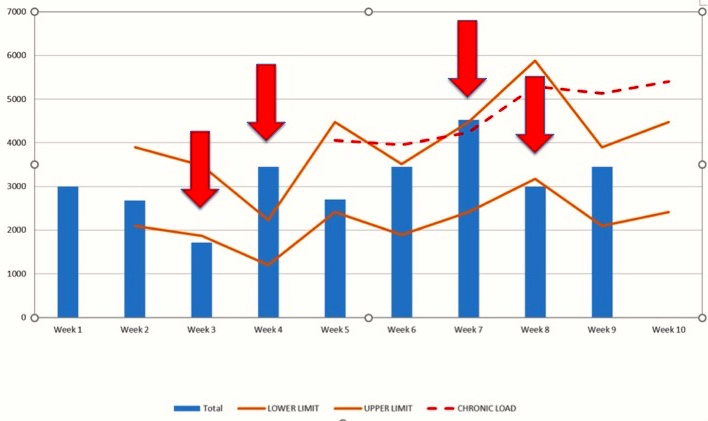
Rule 1: Do not change your training load UP by more than 30% week to week, or reduce by more than 20% week to week. Once you change your load by >30% you are 6 times more likely to injure yourself, if you jump up to a 50% increase it’s 8 times more likely. DANGER!

Rule 2: Chronic vs. acute training load. Chronic training load is the average of your last 4 weeks of training. Acute training load is what you did this week. If your acute load is >150% of your chronic load then you more than double your chance of injury. DANGER!

Rule 3: The injury often presents 2-3 weeks after the training load error for soft tissues and 4-6 weeks for bone. So often you need to think back to what you have done over the past month to find out where you went wrong.

Here is an example of one of our athletes who didn’t realise they were breaking these training rules. Over 9 weeks of training these rules have been broken 4 times (red arrows). Now in reality you can’t always stick perfectly to these rules. Thankfully breaking them once doesn’t guarantee injury, but it does increase your likelihood. Instead you can use these rules as an early warning. If you have done to much training (or to little) then you might want to consider increasing your maintenance work (stretching, massage, physio) and being careful with high risk training sessions the following 2 weeks, or return from a week of holiday/sickness more graded

. If you have no idea where to start then talk to your coach, or book a consult (ph 5500 6470) with one of our Exercise Physiologists, to get a good starting point and plan a build from there.

Loading...