13/345 Southport-Nerang Rd, Ashmore Q 4214
12/110 Kortum Drive, Burleigh Heads Q 4220

Attention Kokoda Challenge Competitors

Get your MUST have Kokoda event gear right here

With a week to go before the 2016 Gold Coast Kokoda Challenge make sure you and your team re stocked up with race essentials to get you through the event! As used by Kokoda Champion all ladies winning team of 2013 & 2015.

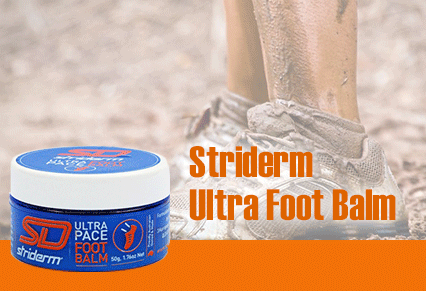
We have extra stock of STRIDERM anti chafe & foot balm available at both clinics (Burleigh & Runaway Bay) $19.95 each

Foot Blister Protection | Long Lasting | Balm
Do you want to be a step ahead with your protection?
Striderm Ultra Pace Foot Balm provides protection from foot blisters for endurance activities. When you apply Ultra Pace Foot Balm to your foot, it is covered by a smooth, non-greasy coating. It reduces friction, is water repellent, and does not lock moisture into your skin. This means that you will be able to exercise in comfort.

Skin Chafe & Foot Blister| Smooth Protection | Endurance

Are you ready for some smooth protection from skin chafing & foot blisters?
Striderm Anti Chafe Extreme provides long lasting protection from thigh chafing, nipple chafing, groin chafing, under breast chafing, under arm chafing, between buttock chafing, and foot blisters.

When you apply Anti Chafe Extreme your skin is covered by a smooth, colourless, non-greasy coating that you hardly know is there. It reduces friction, is water repellent, and does not lock moisture into your skin. This means that you will be able to exercise in comfort.
You will feel the ingredients work immediately upon application. They are more mobile on skin than wax based products and are significantly less messy than petroleum jelly. You are able to use a mild detergent to wash the product off after you finish your activity.
The Roll-On delivery system makes it easy for you to apply the protective ingredients directly to those areas that you want to protect from skin chafing and foot blisters. You will find that the roll-on system is more robust than a wax-stick system and does not have the wasteful spray drift of spray based products.
Striderm Anti Chafe Extreme contains a blend of silicones that combine to reduce friction, provide a barrier on your skin, and deliver a smooth finish. It also contains aloe vera, but does not contain water, fragrance, mineral oils, or petroleum jelly.

Available at Burleigh & Runaway Bay clinic ph 07 5500 6470

Tips to maximise your Nutrition for Endurance Events

nutrition gold coast

Eat, Drink & Supplement your way to success in Endurance and Ultra-endurance Events

By Amelia Webster, Accredited Sports Dietitian. Gold Coast Physio and Sports Health

Focus first on Training Nutrition & Hydration

Training for an endurance event requires careful and meticulous planning of training programs, load monitoring, recovery strategies and much much more. However, we as Sports Dietitians, often only see athletes in the final weeks leading up to a race in order to develop a “race day fuel and hydration plan”. While this is an excellent, and somewhat critical, final piece to the puzzle……if your race day plan is the main or only focus of your nutritional strategies, you are missing some crucial opportunities along the way to “train nutritionally” for your event. The number of hours spent training for your event, will always far outweigh the number of hours spent competing, so fuelling and hydrating to get the most out of your sessions is key to being ready on the day. As a Sports Dietitian, I can review your pre, during and post training, nutrition and hydration practices for you and even provide advice on your nutrition for immunity, as getting sick and having time away from training is the last thing you need leading into your event.

Try it in Training and Try it again (and maybe again, just to be sure).

Say it with me……. NEVER EVER try ANYTHING new on the day of a race/competition/event! If you haven’t trained with it (meaning the type of fluid/food, the amount and/or timing) then DON’T use it. Unfortunately, I have many horror stories of clients trying new gels, foods, different electrolyte drinks and getting cramps, stitches, diarrhoea, vomiting and stomach pains which have forced them to them to slow down significantly and sadly in many cases, fail to make it to the finish line altogether.
The chances of experiencing Gastrointestinal issues in an ultra endurance event, can be reduced by trialling your nutrition and hydration plans in race pace simulated training sessions.

Some keys things to note when training with nutrition:
1. What is your pace/total time running (both for training and event runs)
2. What is your preferred method of nutrition (i.e. gels, drinks, bars, lollies etc)
3. How are you going to carry your nutrition
4. On your route do you have access of water/fluid
5. Pre-training nutrition and hydration strategies
Pace/Total Time

Why is this important I hear you ask? Your body can only store enough glycogen (stored glucose) to keep the body running for ~90minutes (this doesn’t take into consideration utilisation of your fat stores which occurs running at a lower intensity), therefore if your marathon time is anything upwards of 90mins, fast acting carbohydrates that can be available and delivered quickly to your muscles will be important. When we are developing a race plan for an individual, generally speaking, we aim for 30-60g of carbohydrate per hour. While this might seem like quite a large range, we would tailor the amount depending on the length of the race, your ability to consume carbohydrates while competing, and importantly, your pace, as the faster you are going, the more carbohydrates you will burn per hour.
So if we use a marathron as an example. OK, so you are planning to run a marathon in about 4 hours you would need 30- 60g (0-1hr) +30-60g (1-2hrs) +30-60g (2-3hrs) + 30-60g (3-4hrs) = a minimum of 120g, up to 240g carbohydrates over the course of the event.

Preferred method of nutrition

This varies greatly between individuals, and be aware that, just because one method works for one competitor, doesn’t mean it will work for you. An event that involves significant amounts of running, has a big impact on your GI tract and it is common for individuals to experience GI upset if eating or drinking too much at one time. It can be tricky therefore to balance meeting carbohydrate needs for refuelling and minimising GI distress. One method many athletes utilise to maximise carbohydrate intake, in a convenient to consume form, (especially while running), are gels. Now it’s important to note that not all gels are created equal. They can vary in terms of taste, carbohydrate load, ease of use, the fluid intake required when taking them and added ingredients such as caffeine). Generally gels have roughly ~25-30g of carbohydrates, and sports drinks such as Gatorade/Staminde/Extend/Endura/Powerade drinks have ~30g carbs in 500ml. For convenience and to decrease possible GI distress I usually recommend gels more than liquids BUT liquids serve a very important role in your hydration status so working between the two can help meet your carbohydrate and fluid needs. Be sure to try different gels in training to get the best one for you…it can take a few trials to find ones that appeal to you. It may be worth finding a couple of flavours, as in very long events, you may end up consuming a number of these and the last thing you want it flavour fatigue! Events where there is a bike component, you may find you are able to consume some “solid” (but still easy to digest) foods which may also provide an opportunity to include some carbohydrate in different forms and flavours. E.g a salty food option, and this might make a nice change from sweet drinks, gels and bars.

Carrying nutrition

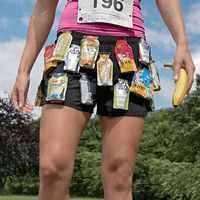
Running belts such as these can be a great tool to assist with meeting your during race nutrition needs. If you are aiming for a sub 4 hours in a marathon for example, your race day nutrition strategy might be one gel every 30 mins, therefore to meet your carbohydrate needs, you would be looking at carrying 7-8 gels (spares are always recommended). So a belt such as this is ideal. There are many types of belts to choose from just make sure you train wearing it on your long runs, especially if you have a bottle holder (2 or 4) belt to know the weight you will be initially running with, where it sits best to minimise movement and also if you get any chaffing from it.

Water/Fluid access

This is a really important issue that does get overlooked when trialling nutrition, most gels NEED to be consumed with water for them to work effectively. Too much carbohydrate in one hit without the appropriate amount of fluid with it, can slow down gastric emptying and reduce the availability of the carbohydrates and could also lead to GI distress. Many gels have instructions either on the package or on their website so make sure you research what your particular gels require. As a guide I recommend a minimum 150-200ml water every gel, check your course for water/fluid stations so you can time your nutrition to have access.

Pre-training nutrition and hydration strategies

If you start a race glycogen depleted or dehydrated you are going to struggle to complete the event, or at the very least, your performance will be severely affected. So how do you do you make sure you have enough glycogen on the day (training and race day)? When I am developing a pre race meal plan, I will base it around meeting the required carbohydrates (we determine this amount by via a grams of carbohydrate per kilogram of body weight ratio). One the total carbohydrate requirement has been calculated, it is translated into meal and snack plan for the 24-36 hours before the event. For many athletes, this will require eating every 2-3 hours as the volume cannot be easily squeezed into just 3 meals per day. When developing a meal plan, I always take into account practical issues, such as where you will be the day before, what access to food and or cooking equipment you might have (especially if you have travelled away from home to compete) and also comfort issues e.g. what you like and feel good eating. I recommend minimising high fibre, high fat and spicy foods before a big run and keeping foods simple. My general rule of thumb is to keep things as familiar as possible to you the day before the race/event. The morning of the event, I help athletes design a breakfast that has a little bit of protein (to helps to fill you up, as it will be some time before your next proper meal) but primarily, I focus on getting some carbohydrates into your body to replenish your fasted state. Again, keep this meal low in fibre and fat and importantly, make sure you have trained on this type of breakfast before.
Hydration is also an extremely important component when competing in endurance events. A 2-4% decrease in body weight can cause fatigue, decreased endurance capacity, headaches, nausea, overheating and heat cramps….any of which will make an already physically challenging event more difficult. A quick and easy way to check that you’re hydrated prior to starting is to keep an eye on your urine. If your urine is fairly clear and you are going to the toilet regularly, you are most likely well hydrated. Concentrated, dark yellow urine, is often a tell tale sign you are not adequately hydrated. Consuming plenty of fluids at meals and snacks in the day leading up to the event and a minimum ~200-300ml water at breakfast the morning of is a good tip. It is nearly impossible to recommend an amount of fluid you should be consuming during the event, as everyone’s rehydration needs will vary depending on their individual sweat rate. I can provide you with information about how to learn to estimate your fluid losses, and develop a hydration plan for your event. For many athletes, if sweat losses are unknown, we plan to keep race fluid intake at a steady pace of ~150-200ml every 20mins.
So with that said, GOOD LUCK for your upcoming events and I look forward to working with you to plan your training and competition nutrition strategies.

SPECIAL OFFER: Mention this article when booking your appointment for an individualised endurance event nutrition plan with Amelia Webster, Gold Coast Physio and Sports Health’s Accredited Sports Dietitian, and receive 10% off your initial consultation until the end of July 2016.

5 Tips to Survive Kokoda Challenge by Ultrarunner Caine Warburton

5 Tips to Survive Kokoda Challenge Gold Coast as your team of 4

Words by Ultra- Runner, Sky Runner Ambassador & GCPSH Sponsored Athlete, Caine Warburton
follow Caine’s blog at Running on the Edge

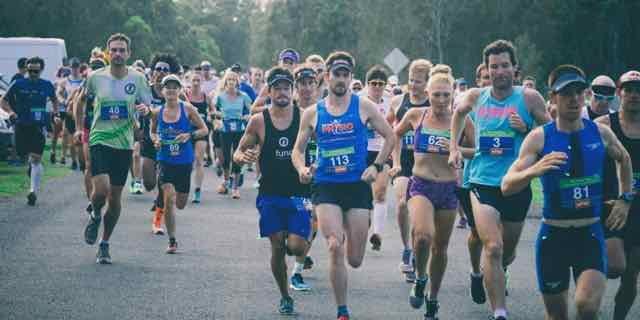
The Kokoda challenge race is without a doubt a fitting tribute to the punishment and difficulty that soldiers experience in PNG along the Kokoda Track. With steep climbs, harrowing descents, mud, water and at times tears the Kokoda Challenge will be, for a lot of people, the ultimate endurance test.

However, it is not all misery and despair as the race is achievable with a little training, effort and a smart approach.

Being experienced in Ultra distance mountain races and having previously fielded the winning Kokoda challenge team in 2013 I have summarised my tips for a successful Kokoda Challenge race below.

1.    Mates are the Key:  the race itself is all about team work and as such you need to finish with all of your members alive and intact to record an official time. Getting all four of you across the finish line will come down to good Team work and a solid understanding of your  team dynamics. Its important to get to know your team mates, go out training and learn about who they are, what they like, what they don’t like, who has what strengths and what are their weaknesses. This information will allow you to provide the right type of encouragement to each person when the going gets tough (and it will), not everyone responds positively to being yell at!!

2.    You are only as fast as the slowest person: When it comes to selecting the right pace to run/walk at it is vital that the pace is not too fast. Many teams each year go out to hard and burn out their weakest/less fit member in the first 20-30km of the race. This usually results in a long day for everyone with lots of suffering and cramping for the less fit and frustration for others. A good technique is to be honest with each other and when one of your team members starts to feel bad or tired put them at the front to set the pace. If you ensure your slowest/most tired person is always at the front then you will never go faster than what your team is capable of.

3.    Checkpoints beware: Throughout the race you will come to a number of checkpoints/aid stations where you will be able to see your crew, fill up water, change clothes and pick up food. These checkpoints can be great morale boosters and are key assets to help you complete the course. However, it is important not to dwell to long in them as every moment in a checkpoint is a moment you are not completing course. Many teams lose hours in checkpoints for no good reason, at night the warmth of the checkpoint will be very inviting but you can’t stay there (if you plan to finish) and will have to go back out into the cold night eventually. A good rule to follow is to be in and out of the checkpoint in about 5-10min, long enough to fill water and change what equipment/clothes you need. Instead of eating your food in the checkpoint grab it and walk out eating as you go then at least you are still covering the course and getting closer to the finish with each step.

4.    Test and trial gear: Having good equipment that will aid not hinder you in the race is very important. Blisters, broken backpacks and chafed thighs are all too common in the Kokoda challenge so make sure you test everything out (more than once) on a long run/walk BEFORE the race day. If something doesn’t work then change it out, if your shoes give you blisters try another pair, if your shorts rub wear some tights!. It sounds simple but all too often new participants come unstuck using equipment on the day they didn’t test beforehand.

5.    Dig deep and then dig some more: It is going to hard, very very hard!! But that is what you signed up for and that is what it is all about. Mentally preparing for the race means coming to terms with the fact you will hurt, you will be cold, hot, tired and uncomfortable…yet you will still need to keep pushing forward. To help you in the tough times try using mantras, counting to 10 with your foot steps, listening to music or better yet remembering how hard the soldiers in PNG had it and how they persevered through conditions much worse than we will ever experience in the race.

For more information about Kokoda Challenge Gold Coast or other events, go here

Benefits versus Risk of Trail Running

I love trail running, but there are some associated Risks….

Written by APA Titled & Olympic Sports Physio Britt Caling

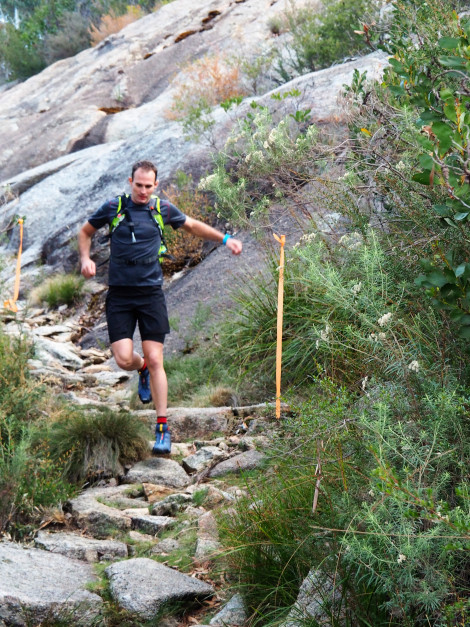
There are many benefits of adding a little off-road/ trail running to your run training from both a performance and technique perspective and a reduction in the risk of injury. However, there are also some risks associated with hitting the trails. Below I discuss the benefits and risks of trail running from an injury perspective:
Benefits:
–    Running on dirt, trail or even rocky surfaces means for a softer surface at foot strike which reduces the impact forces transferred to the body. This will reduce your risk of bone stress reactions and stress fractures. If you are an athlete who experiences regular shin splint pain with road running or if you have experienced a bone stress injury that has limited your running then adding some trail running to your training may be useful to avoid missing run training due to soreness or injury.

–    Trail running, especially rocky surfaces, means that each foot strike tends to be different. This helps reduce recurrent and repeated impact forces and reduces your risk of repetitive overuse injuries such as bone stress, ITB friction syndrome and some hip injuries.

–    Running uphill and technical trails means you will naturally shorten your stride length. This is great for runners who regularly over-stride and have injuries related to this, including shin splits, ITB friction syndrome, hamstring tendon pathologies and patellofemoral joint knee pain.

–    If you include uphills in your trail running, there is an overall additional strength loading on your tissues, especially your glut maximus, hamstrings and calf/achilles.

–    Trail running is great for improving ankle and foot strength and stability.

The main risks associated with trail running are related to acute trauma or too much steep hill running and include:
–    Ankle sprains and other injuries (such as a small bone fracture in ankle, fibula or toes or a peroneal tendon tear) associated with an ankle/foot twist episode. When running on technically challenging surfaces (particularly rocky or slippery surfaces) you may step on a rock/branch/acutely angled surface that can cause excessive stretching forces to tissues and then damage to these tissues. The best way to prevent this is to tape your ankles and learn the skill of running off-road (ie where to look when running and how to place your foot). Other balance exercises can be used to help you develop strong feet and ankles. Also, if you are running on a very challenging surface, be cautious with your speed until you have stronger feet and ankles and are technically better at running off-road.

–    Knee ligament sprains. Again, stepping on a surface that may move or cause you to slip can put your knee in an awkward position that can overstress your ligaments. The prevention for this is as above for acute ankle injuries.

–    Low back pain. When running uphill (and particularly long or steep hills like you often get trail running) you will lean forwards at your trunk. Low back pain can therefore result from adding steep hills into your run when you are not conditioned to them or if your low back muscles are too weak to hold your trunk posture. To prevent this, be sensible with the addition of hills into your training; consider using walking poles (I prefer to call them running poles!) if the hill is very steep and/or will involve hiking; and do some back strengthening exercises such as plank holds as part of your training week.

–    Patella Tendon (in the knee) overload and patellofemoral (kneecap-to-thigh) joint pain. This will usually only result from excess, steep hill training with not enough recovery on your tendon and not enough maintenance (ie massage) on reducing the extra tension in your quads muscles that develops from lots of hill running. Prevent these problems by being smart with your training program and include recovery plus a gradual introduction of hills, and make sure you get regular massage, or at least do your own massage, foam roller or trigger-pointing.

–    Foot pain. If the off-road surface you are running on is rocky and you are wearing shoes with inadequate support or grip then your feett can move around excessively in your shoe and your forefoot (front of foot) or rearfoot (heel) can be put under greater mobility stress. This can cause some foot soreness or stress to your plantar fascia so ensure you wear correct off-road shoes.

My final piece of advice: if you are new to off-road running, take a phone with you just in case an injury were to happen and you need to call for help.
Otherwise, make the most of appreciating the beautiful environment you are running in and stay safe!

Loading...