Problems with squatting??
Did you know that not everyone’s squat position will look the same? Some people will have a nice deep squat position and some people will never be able to squat below parallel. Many people blame their flexibility and say they need to stretch more, however this is not always the case. For some people now matter how much they stretch they will never be able to achieve a deep squat position because of their individual anatomy.
There are many factors that will affect the type of squat that will be best for you. Firstly your ankle range of motion will play a part in how deep you can squat. If your ankles are stiff and your knees are unable to shift forward over your toes then your bottom will have to shift backwards instead of dropping down. This means your squat position will not be as deep. You can stretch your ankles to help with this range of motion, or if you prop your heels on a small plate then this will mean you don’t need as much range of motion from the ankle and will allow your bottom to drop down further.
The ratio of your limb length will also effect your squat position. If you have relatively short femurs compared to your tibias then you will be able to drop straight down into a good position. If your femurs are long then your bottom will shift backwards and torso forwards to keep your center of gravity over your base of support. Again if you prop your heels up on a small plate this will help you achieve a deeper more upright position. This is one of those issues that will obviously not change no matter how much you stretch. So rather than trying to change your body to achieve a deeper squat, accommodate the squat position to your anatomy.
Hip range of motion plays a big role in what your squat will look like. Everyone’s hips are different. Some people’s sockets face more forward, other more to the side. Some people’s sockets are deeper and some are quite shallow. The neck and head of the femur will also be different. Some people may have extra bony growth around the neck of the femur which will limit how far the hip can flex. Also the angle of the neck of the femur will effect how the hip joint moves. This is why some people will feel more comfortable with a narrow foot position, and others will need to have a much wider foot position.
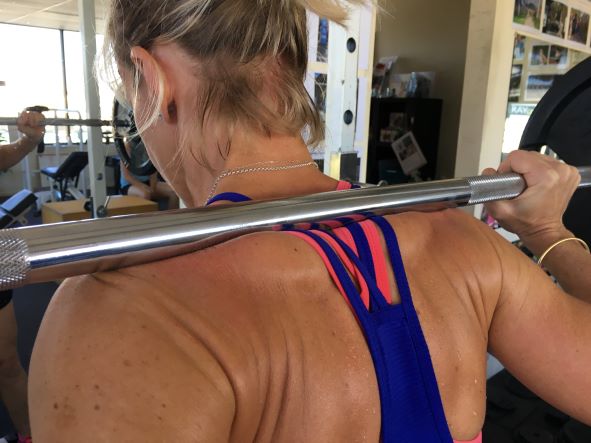
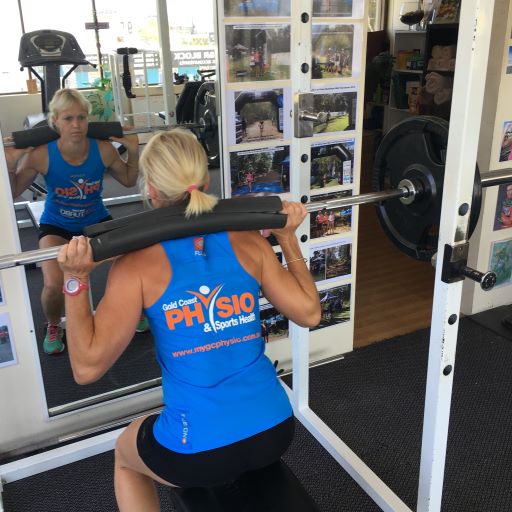
Squat depth will always be limited for those who have a deep hip socket or extra bony growth around the hip joint. This is because as the hip flexes it will hit a bony end point. Trying to push range of motion for these people can lead to irritation of the hip joint, pinching of the joint capsule or tearing of the labrum (cartilage inside the joint). For this reason people with this type of anatomy should always limit their squat depth. The best way to do this is to squat down to a box or bench. Again propping the heels up on a small plate will allow the torso to stay more upright resulting in less hip flexion. The bar position can also effect how much the hip has to flex. Holding the bar in a low position (across the posterior deltoid) will cause the torso to lean further forward causing more flexion at the hip. However if you hold the bar in a high position (on top of the upper traps) or even in a front rack position (across the front of the shoulders) this will keep the torso more upright resulting in less hip flexion.
There are some people who’s hips aren’t limited by a bony block, rather just muscle tightness or connective tissue stiffness of the joint capsule. This means there is potential to increase range of motion by stretching the hip joint. However, generally for these people their tissues have a higher percentage of collagen and a lower percentage of elastin making them “stiffer” and less stretchy than others. If this is you, then you will need to be extremely diligent with stretching to notice a difference in your mobility. Also stretching before you train combined with a good warm up will be important to help you get into a more optimal position while squatting.
Another common issue with squatting is known as a “butt wink”. This is when the tailbone tucks under in the bottom position causing flexion at the lumber spine. This is actually quite dangerous as lumbar flexion while having a weight across the shoulders puts a lot of pressure on the intervertebral discs and increasing potential for a disc injury. There are a number of reasons why people may have a butt wink. It could be because the hip has reached its end range of flexion, so to get deeper into the squat the spine will flex. If this is the case then the squat depth should be limited due to the risk of injury in this position. The other reason this can be happening is weakness in the muscles that keep the back in a nice upright position. If this is the case then specific exercises may be needed to strengthen the muscles that keep the back straight.
In short rather than getting frustrated about not being able to get “ass to grass” with your squat, understand why this might be the case. This will help you accept that you may never have a deep squat, and perhaps feel more comfortable with making adjustments like propping your heels or limiting depth. For some people squatting just isn’t the most effective movement pattern from them, and perhaps using other movements to develop leg strength will be a better option.
If you’ve been having issues with your squat and would like an assessment. Contact the clinic and book an appointment so we can identify your limitations and make adjustments as necessary – phone us on 07 5500 6470